May 14, 2026
Key Takeaways:
- Egg Mass Identification: Finding and destroying egg masses between September and May is the most effective way to reduce the 2026 population.
- The Honeydew Threat: This sticky excretion leads to sooty mold, which can kill understory plants and ruin outdoor furniture in Union backyards.
- Host Tree Removal: Eliminating the Tree of Heaven (Ailanthus altissima) removes the primary breeding ground for these invasive pests.
- Professional Systemics: For large maples and walnuts, professional systemic injections offer the highest kill rate with the least environmental impact.
- Community Vigilance: Coordination between neighbors in Union County is essential to prevent the pest from hopping from yard to yard.
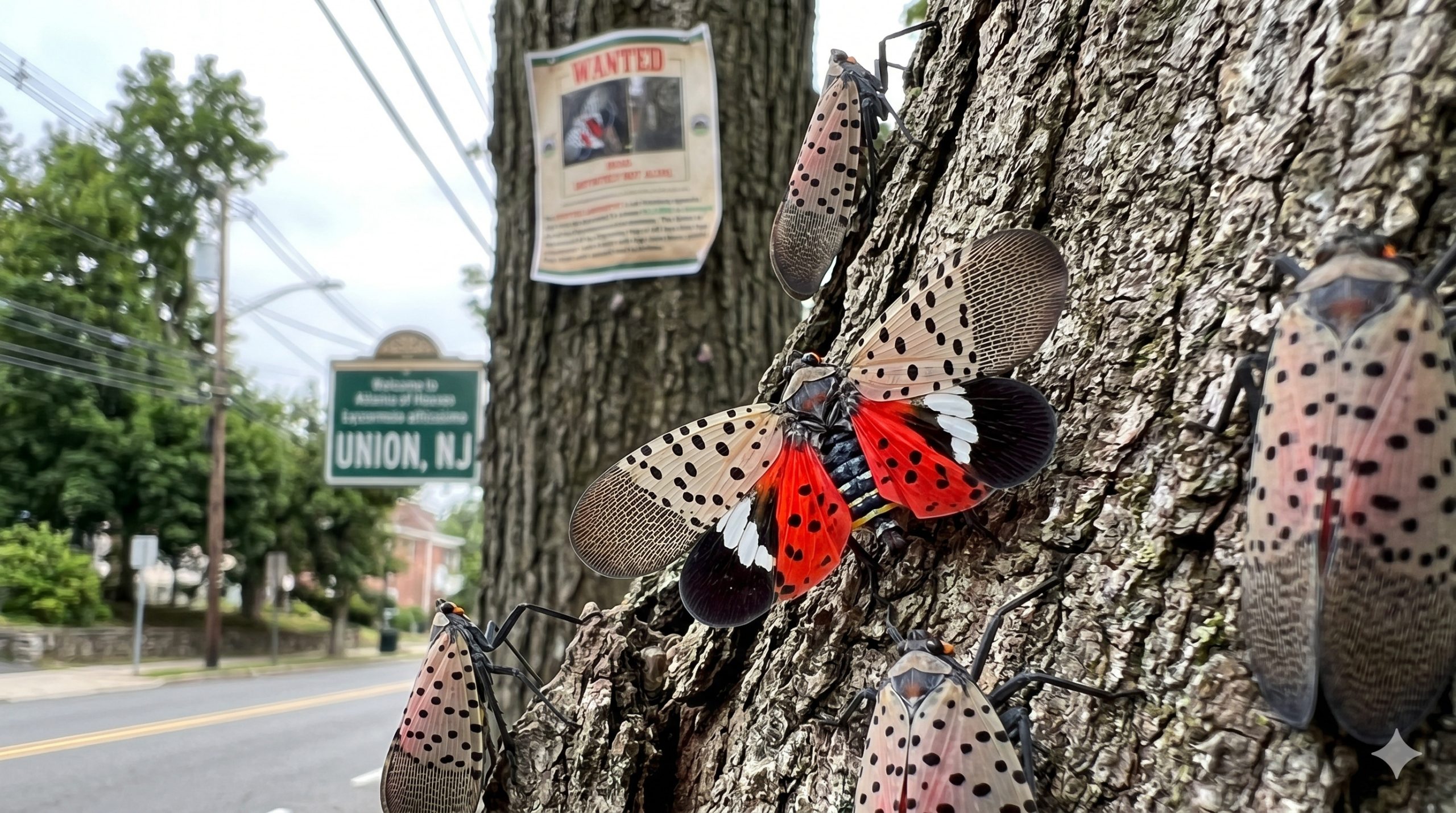
Residents of Union, New Jersey, have become all too familiar with the colorful but destructive spotted lanternfly. Since its initial arrival in the Garden State, this invasive planthopper has transformed from a localized nuisance into a significant threat to our local ecosystem and property values. As we move through 2026, the management strategies have shifted from simple observation to aggressive, localized intervention.
To protect your property, you must understand that the lanternfly is not just a bug that lands on your shoulder; it is a plant-stressor that can weaken even the sturdiest silver maples and black walnuts found in Union County. By identifying their life stages and acting during the dormant winter months, you can significantly decrease the number of adults that will swarm your patio come July.
The 2026 Situation: Why Union remains a Hotspot
Union Township is uniquely positioned for lanternfly activity due to our mix of residential green spaces, older tree canopies, and proximity to major transportation corridors like the Garden State Parkway and Route 22. These insects are notorious hitchhikers, often laying eggs on vehicles or shipping containers that then travel into our neighborhoods.
In 2026, we are seeing a stabilization of the population in some areas, but a resurgence in others where host trees like the Tree of Heaven are prevalent. The primary concern this year is not just the physical presence of the bugs, but the secondary damage caused by their feeding habits. They use a piercing-sucking mouthpart to drink the sap directly from the tree’s vascular system, essentially dehydrating the tree from the inside out. When hundreds of these insects congregate on a single branch, the cumulative stress can lead to branch dieback and, in some cases, the death of younger or already stressed trees.
The Most Effective Weapon: Winter Egg Scraping
The most critical window for management in Union, NJ, occurs when the temperatures drop. Between late September and early May, the adult lanternflies die off, leaving behind gray, mud-like egg masses on nearly any flat surface. This is the stage where the individual homeowner has the most power to impact the following year’s population.
Identifying the Egg Masses
An egg mass looks like a smear of gray clay, roughly an inch long. When they are fresh, they have a shiny, waxy coating, but over the winter, they often become cracked and look like dried mud. They are frequently found on the underside of tree limbs, but in a suburban environment like Union, they are just as likely to be on your fence, the underside of your grill cover, or the wheel wells of your car. Each mass contains between 30 and 50 eggs. By destroying one mass now, you are preventing dozens of hungry nymphs from hatching in the spring.
The Proper Scraping Technique
To effectively kill the eggs, you cannot simply knock them onto the ground. You need a plastic card or a putty knife and a small bag filled with rubbing alcohol or hand sanitizer. Firmly scrape the mass into the bag, ensuring that the individual seed-like eggs are submerged in the liquid. If you simply crush them on the bark, some eggs may survive the winter and hatch anyway. It is also important to check non-plant surfaces; these pests have been found laying eggs on patio stones, outdoor playsets, and even rusted metal equipment.
Managing the Host: The Tree of Heaven Connection
The spotted lanternfly has a biological preference for the Tree of Heaven. This invasive tree is common along the railroad tracks and fence lines in Union. While the lanternfly will feed on over 70 different plant species, they almost always return to the Tree of Heaven to complete their reproductive cycle.
If you have this tree on your property, it is acting as a lighthouse for every lanternfly in the neighborhood. Removing these trees is a highly effective management strategy. However, simply cutting them down often causes the roots to send up dozens of new shoots because of the tree’s aggressive colonial growth habit. A professional approach involving targeted herbicide application to the stump, often called the hack and squirt method, is usually necessary to ensure the host is truly gone.
The Problem with Honeydew and Sooty Mold
One of the most frustrating aspects for Union homeowners is the sticky residue known as honeydew. As lanternflies feed, they excrete a sugary liquid that coats everything beneath the tree. This includes your deck, your car, and your lawn. Because the lanternflies lack a complex digestive system, the honeydew is essentially concentrated tree sap.
Within days, a black, velvet-like fungus called sooty mold begins to grow on this sticky surface. While sooty mold does not directly kill the tree, it blocks sunlight from reaching the leaves of smaller plants below, eventually killing your landscape’s understory. It also creates a foul odor and attracts stinging insects like wasps and hornets, making your backyard nearly unusable during the peak of summer. For residents with large silver maples overhanging their driveways, this can lead to permanent damage to car paint if the mold is allowed to bake in the sun.
Professional Management and Systemic Treatments
For the large, ornamental trees that define the beauty of Union neighborhoods, manual scraping is often not enough because the insects lay eggs high in the canopy where they cannot be reached. This is where professional intervention becomes necessary.
Systemic insecticides are the most effective way to protect a specific high-value tree. These treatments are applied either through soil drenching or direct trunk injection. The tree absorbs the treatment into its sap. When a lanternfly bites into the bark to feed, it ingests the insecticide and dies. This method is far superior to traditional spraying because it targets only the insects feeding on the tree, significantly reducing the risk to beneficial pollinators like bees and butterflies. In 2026, we are finding that a single application in early summer can protect a tree for the entire season.
Managing a lanternfly infestation requires a combination of biological knowledge and the right equipment. New Jersey Tree Professionals specializes in safe, expert tree removal services across Union County and surrounding areas. With over 40 years of experience, our licensed and insured crews handle hazardous or decaying trees with precision and care. We offer crane-assisted removals for hard-to-reach trees, 24/7 emergency services, and transparent pricing with a No-Surprise Guarantee!
Frequently Asked Questions by Homeowners in Union, NJ
Are spotted lanternflies dangerous to humans or pets in Union, NJ?
No. They do not bite, sting, or carry diseases that affect people or animals. They are purely a threat to plant life and a general nuisance in the yard.
Will a typical New Jersey winter kill the egg masses?
Unfortunately, no. These eggs are incredibly hardy and have survived Northeast temperatures well below zero. Manual scraping is the only way to ensure they do not hatch in your yard come May.
Can I use sticky traps on my maples to catch the nymphs?
Sticky traps can be effective, but they must be used with a mesh guard. Without a guard, you risk catching birds, squirrels, and beneficial pollinators. Circle traps are generally considered a safer and more effective alternative in Union neighborhoods.
Why is my silver maple dripping sap in July?
That isn’t sap; it is likely honeydew excreted by a large number of lanternflies feeding high in the canopy. This sticky residue will soon lead to black sooty mold on your driveway or deck if the insects aren’t managed.
Does the Township of Union provide tree removal for lanternflies?
Generally, tree maintenance on private property is the responsibility of the homeowner. However, the township may manage heavily infested Trees of Heaven in public parks or along municipal right-of-ways if they pose a structural risk.
If I see a spotted lanternfly in Union County, should I report it to the state?
In 2026, the NJ Department of Agriculture is primarily interested in reports from counties where they are not yet established. Since Union is a known infestation zone, your best move is to destroy the insect and manage your own property.
Are there any natural predators for them in the Union area?
Some local birds, spiders, and praying mantises have started to eat them, but their numbers are not high enough to control the population. Human intervention remains the most effective control method.
Why do they congregate on my white vinyl fence?
Lanternflies are attracted to light-colored surfaces and vertical structures. They use these as launching points to find nearby host trees like maples, walnuts, or the invasive Tree of Heaven.
Summary Checklist: Spotted Lanternfly Management
| Condition | Risk Level | Recommended Action |
| Visible Egg Masses | High | Scrape into a bag of alcohol immediately to prevent spring hatch. |
| Sooty Mold on Deck | Moderate | Power wash the surface and inspect the canopy above for feeding insects. |
| Presence of Tree of Heaven | Critical | Remove the host tree to eliminate the primary breeding site on your lot. |
| Heavy Nymph Activity | Moderate | Install guarded circle traps or consider a professional soil drench. |
| Adult Swarming | High | Contact a professional for systemic trunk injections to protect large trees. |
Final Advice
Managing the spotted lanternfly in Union County requires moving away from reactive swatting toward a practical, year-round management plan. The data shows that the most successful homeowners partner with a trusted tree service in Union, NJ to protect their trees as long-term assets, rather than waiting for sticky sooty mold to ruin their yards. Your primary defense is eliminating the Tree of Heaven; as long as this invasive host sits on your property or your neighbor’s fence line, your maples and walnuts will remain a target.
Winter egg scraping is just as critical. By destroying egg masses on siding, stone, and vehicles, you break the reproductive cycle before it restarts in May. If you have large shade trees that are impossible to reach and scrape manually, systemic injections are the smartest move to prevent the health decline that eventually leads to costly, hazardous removals.
A healthy tree can handle a minor infestation, but a stressed one will quickly succumb to secondary fungi and dehydration. F
Reviewed by a Certified Arborist
This horticultural analysis has been reviewed to ensure all information regarding tree biology and storm safety meets industry standards.