September 18, 2026
Key Takeaways
- A tree doesn’t need to look sick to pose a structural risk to your home.
- Leaning, cracking, and root disturbance are among the most reliable indicators of instability.
- Fungal growth on a trunk is frequently a visible sign of decay that’s already well established internally.
- Trees near a home need a lower threshold for concern than trees standing in open areas of a yard.
- A certified arborist’s evaluation can confirm whether corrective work or removal is the right response.
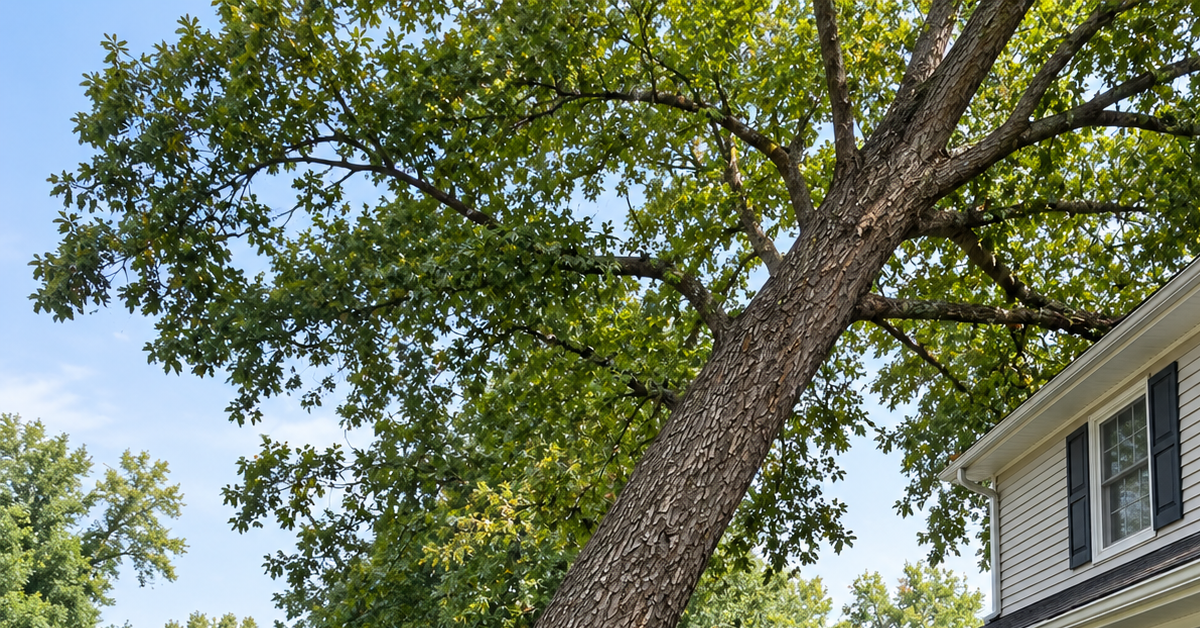
A tree standing near a New Jersey h home is doing more than providing shade. It also plays an important role in the landscape, but its proximity to structures means any structural failure can have serious consequences. A weakened tree or unstable limb can damage a roof, vehicle, driveway, fence, or even put family members and visitors at risk if it falls unexpectedly. Because trees can develop internal problems that are not always visible from the ground, understanding the warning signs is an important part of responsible property care.
Most homeowners aren’t trained to evaluate a tree’s structural condition, and that is completely normal. However, there are recognizable indicators that every property owner can learn to watch for, including sudden leaning, trunk cracks, root damage, fungal growth, and unusual canopy decline. Identifying these signs early allows homeowners to seek professional guidance before a minor concern becomes a dangerous situation or costly emergency.
Signs Your May Be a Structural Hazard
Knowing these 6 signs can be the difference between catching a problem early and dealing with an emergency after a storm.
1. A Trunk That Leans or Has Recently Started to Lean
Some trees grow with a long-standing, gradual lean that has been part of their natural form for years, and this kind of established lean is often stable and not an immediate concern. What matters far more is a lean that is new or has visibly increased, particularly if it appears alongside cracked, lifted, or disturbed soil at the base of the trunk. This combination usually points to the root system losing its grip in the soil, and it’s one of the more urgent signs on this list, since a tree that’s actively shifting can fail with very little additional stress from wind or rain.
2. Cracks or Splits in the Trunk or Major Limbs
The trunk and major limbs are the tree’s structural skeleton, and any significant crack running along their length is a sign that the wood’s integrity has been compromised. Vertical cracks, especially ones that run for a foot or more, or splits where a limb appears to be separating from the trunk, indicate that the connected wood fibers holding that section together have already failed to some degree. Under the added weight of wind, rain, or ice, these cracks can widen further and lead to a sudden limb or trunk failure, often without much additional warning.
3. Fungal Growth on the Trunk or at the Base
Mushrooms, shelf-like fungal conks, or other fungal growth appearing on the trunk or around the base of a tree are one of the clearest visible indicators of internal decay. These fungi are actively breaking down the wood fiber inside the tree, and by the time their fruiting bodies appear on the outside, the decay process has typically been underway for a considerable period. This is a sign that specifically calls for a professional evaluation, since the extent of the internal decay isn’t something that can be judged accurately just by looking at the outside of the trunk.
4. Exposed, Damaged, or Disturbed Roots
Roots anchor a tree in place and supply the water and nutrients that keep it alive, so any visible root damage is a meaningful red flag. This includes exposed roots from erosion or nearby digging, roots that have been cut during utility work, trenching, or driveway or patio construction, and soil that appears to be heaving or cracking unevenly around the base of the tree. Because construction and landscaping projects are common around New Jersey homes, root damage from past digging work is a frequently overlooked cause of trees that later develop instability, sometimes years after the original disturbance.
5. Deadwood Concentrated Over the House or Driveway
Deadwood anywhere in a canopy is worth addressing, but deadwood specifically positioned over a roofline, driveway, or walkway carries a different level of urgency simply because of what’s underneath it. Dead limbs can fail without warning and without a storm event to trigger them, since the wood itself has already lost the structural strength to support its own weight indefinitely. A tree with visible dead branches hanging directly over living space should be treated as a higher priority than the same amount of deadwood positioned over an open section of yard.
6. Sudden Canopy Thinning or Widespread Dieback
A tree that has noticeably thinned out, or that shows large sections of branches failing to leaf out during the growing season, is signaling a decline that often has a root, trunk, or vascular cause working beneath the surface. This kind of widespread thinning is different from the normal, gradual canopy loss that comes with age. When it happens relatively quickly, over a single season or two, it’s frequently connected to root damage, disease, or an aggressive pest issue, several of which are common concerns for trees throughout New Jersey.
Why Proximity to Your Home Changes the Calculation
A tree showing one or two of these signs while standing in an open part of a yard, away from any structure, may be reasonable to monitor over time. That same tree, positioned so that a partial or full failure would land on a roof, a car, or a walkway where people regularly pass, deserves a much lower threshold for concern and a faster professional response. This is one of the most important distinctions in tree risk assessment: it’s not just about how compromised a tree is, but about what stands to be affected if that compromise turns into failure.
Storms and Weather Events Can Accelerate These Risks
New Jersey experiences a range of storm conditions throughout the year, from summer thunderstorms and occasional high wind events to winter ice and heavy snow loads. Any of these can turn a marginal structural issue into an active failure, and they can also create new problems in trees that previously showed no visible signs of concern. After any significant storm, it’s worth taking a fresh look at trees near the home for new leaning, cracking, or canopy changes, even if the tree came through without an obvious limb failure.
What a Certified Arborist Looks for During a Structural Risk Evaluation
A professional tree service firm in Union, New Jersey can conduct evaluation to identify any structural damage or risk. The evaluation typically includes –
- checking the trunk for cracks, cavities, and decay indicators
- assessing the root flare and surrounding soil condition
- inspecting the canopy for deadwood and dieback patterns; and
- factoring in the tree’s specific location relative to the home and other structures.
This combination allows an arborist to give a clear, specific recommendation, whether that’s continued monitoring, corrective pruning, structural support like cabling, or removal when the risk can’t be reasonably managed another way. One of the most common mistakes homeowners make is deciding to “wait and see” how a concerning tree handles the next major storm before taking action. This approach carries real risk, since a tree that fails does so without a guaranteed second warning, and the consequences of a failure near a home can be significantly more expensive and disruptive than a proactive evaluation and any recommended corrective work.
New Jersey Tree Professional has helped homeowners throughout Union, Elizabeth, Linden, and the surrounding New Jersey communities identify structural risks in their trees before they become emergencies. Our certified arborists inspect the trunk, roots, and canopy on every evaluation, and as a fully licensed and insured, family-operated company, we give property owners honest, straightforward answers about what a tree actually needs.
If a tree near your home is showing any of these six signs, don’t leave the outcome to the next storm. Call New Jersey Tree Professional at (908) 866-8894 for a free estimate and a certified arborist’s assessment.
Frequently Asked Questions About Structural Tree Risk in New Jersey
Is a tree with a lifelong, established lean always dangerous?
Not necessarily. A stable, long-standing lean without recent changes or soil disturbance is often not an urgent concern. A new or worsening lean is the version that calls for prompt evaluation.
Can a tree with fungal growth on the trunk still be saved?
It depends on how much of the trunk’s circumference and internal wood are affected. Some trees can be managed with monitoring or support, while others with advanced decay are safer to remove. A certified arborist can determine which applies.
How soon after a storm should I check my trees in Union, New Jersey?
It’s worth a visual check within a few days after any significant wind, ice, or snow event, and a professional evaluation if you notice new leaning, cracking, or canopy changes.
Does root damage from years ago still matter today?
Yes. Root damage from past construction or trenching can take years to visibly affect a tree’s stability, which is why past digging work near a tree’s root zone is worth mentioning during an evaluation.
What’s the difference between deadwood over a yard versus over my house?
The wood itself may be equally weak in both cases, but deadwood over a home, driveway, or walkway poses a direct risk to people and property, so it’s typically prioritized for removal sooner.
Summary Checklist: Recognizing Structural Tree Risk Near Your Home
| Task | Priority | Recommended Action |
| Watch for new or worsening lean | Critical | Check for disturbed soil at the base alongside any lean |
| Inspect trunk for cracks and splits | Critical | Have significant cracks evaluated by a certified arborist |
| Check for fungal growth | Critical | Treat mushrooms or conks on the trunk as a sign of possible decay |
| Look for root disturbance | High | Note any recent digging, trenching, or exposed roots nearby |
| Address deadwood over structures | High | Prioritize removal of dead limbs positioned over the home or driveway |
Final Advice
A tree near your home can become a safety concern long before it shows obvious signs of failure. Leaning, trunk cracks, root damage, fungal growth, and canopy decline are all warning signs that deserve attention before they develop into a larger hazard. Ignoring these issues can increase the risk of property damage, especially during New Jersey storms involving high winds, heavy snow, or ice. A certified arborist can evaluate the tree’s overall condition and determine whether it can be preserved through corrective care or whether removal is the safest option. Professional assessment helps homeowners make informed decisions based on actual risk rather than assumptions. If you notice signs of structural weakness in a tree near your home, driveway, or walkway, don’t wait until the next storm creates an emergency. New Jersey Tree Professional provides thorough tree evaluations to identify hazards and recommend the safest solution. Contact New Jersey Tree Professional at (908) 866-8894 to schedule a free estimate and protect your property.
Reviewed by a Licensed Arborist
This article has been reviewed by a certified arborist to ensure accurate information about tree hazard identification and structural risk assessment practices in New Jersey.