September 18, 2026
Key Takeaways
- Structural pruning done while a tree is young prevents the weak growth patterns that cause failures decades later.
- Establishing a single dominant leader early avoids the co-dominant stems that are prone to splitting.
- Correcting crossing, rubbing, or competing branches early reduces the need for major corrective pruning later.
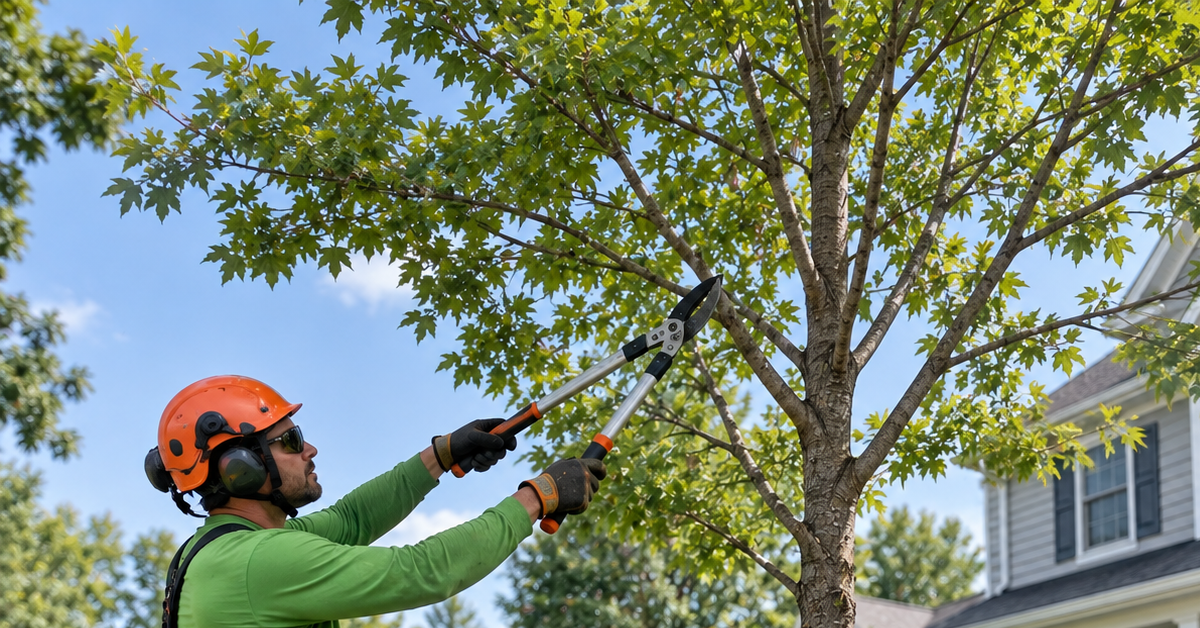
- Young tree pruning uses light, selective cuts, not the heavy reduction sometimes needed on mature trees.
- A structural pruning plan in the first several years after planting is one of the most cost-effective investments in a tree’s lifespan.
Most of the tree problems that end up requiring emergency removal or major corrective work didn’t start as emergencies. They started years, sometimes decades, earlier as small structural issues in a young tree that were never corrected. A weak branch union, a lopsided canopy, or a competing second trunk can all trace back to growth patterns that were present when the tree was only a few years old. For homeowners throughout Union County and New Jersey planting or maintaining young trees, understanding structural pruning and applying it early is one of the most effective ways to avoid costly problems down the road.
Why Structural Pruning Matters More for Young Trees Than Mature Ones
A young tree’s branch structure is still forming, which means the cuts made during its first several years have an outsized influence on how it will grow for the rest of its life. Removing or shortening a poorly positioned branch on a young tree is a minor, low-stress correction. Attempting the same correction on a mature tree, after that branch has grown to a significant size and become structurally established, often requires a much larger cut, creates more stress on the tree, and may not fully resolve a weakness that’s had decades to develop. In short, structural pruning is a preventive strategy, and it works far better as prevention than as a later fix.
Establishing a Single Dominant Leader
One of the most important goals of young tree pruning is establishing and maintaining a single dominant central leader, the main upward-growing stem that will become the tree’s primary trunk. Many young trees naturally develop competing leaders, sometimes called co-dominant stems, where two stems of similar size grow upward together instead of one clearly dominant trunk. This growth pattern creates a structurally weak union between the two stems, often with included bark trapped in the joint rather than solid wood, which makes that union significantly more prone to splitting as the tree matures and the stems grow heavier. Correcting this early, by selecting the stronger, better-positioned stem as the leader and pruning back or removing the competing stem, prevents this weak union from ever fully developing.
Selecting and Spacing Scaffold Branches
Scaffold branches are the major limbs that will form the framework of the tree’s mature canopy, and structural pruning in the early years focuses on selecting which branches should remain as part of that framework. An experienced tree service firm in New Jersey generally looks for branches with a wide, strong angle of attachment to the trunk, since narrow angles tend to develop weaker unions over time. Spacing matters as well: branches that are too closely stacked vertically or clustered around the same point on the trunk can create crowding and future competition for light and space, so structural pruning often involves selectively removing some branches to establish better vertical and radial spacing among the ones that remain.
Removing Crossing and Rubbing Branches
Branches that cross or rub against each other create ongoing wounds where the bark is repeatedly damaged by contact, and these wounds can become entry points for decay-causing organisms. In a young tree, it’s far simpler to remove one of the two branches while both are still small than to deal with the consequences of years of accumulated rubbing damage on a mature limb. Structural pruning addresses these conflicts early, before either branch becomes large enough that removing it represents a significant cut or a meaningful loss of canopy.
Managing Branch-to-Trunk Size Ratio
A branch that grows too large relative to the trunk it’s attached to can eventually become a structural liability, since an oversized limb places more stress on its point of attachment than the union was built to support. Structural pruning helps manage this by selectively slowing the growth of branches that are becoming disproportionately large compared to the trunk, keeping the overall framework more balanced. This is a subtle, ongoing consideration during a young tree’s early pruning cycles rather than a single correction made once.
Timing Structural Pruning Correctly
Young trees generally benefit from structural pruning during the dormant season, in late winter, when the absence of leaves makes it far easier to see the tree’s branch architecture and identify co-dominant stems, narrow branch angles, or crossing limbs. Light corrective pruning can sometimes be done at other times of year if a specific issue, like a broken or damaged branch, needs prompt attention, but the more involved structural shaping is typically most effective and least stressful for the tree when done during dormancy.
How Often Young Trees Should Be Pruned
Unlike mature trees, which are often pruned on a multi-year cycle, young trees generally benefit from a lighter pruning visit every one to two years during their first five to ten years in the ground. This more frequent schedule allows an arborist to make small, timely corrections as the tree’s structure develops, rather than needing to make larger, more significant cuts to correct issues that have had several years to become established.
What Structural Pruning Is Not
It’s worth distinguishing structural pruning from more aggressive practices that can actually harm a young tree’s development. Topping, or cutting the leader or major limbs down to stubs, is never part of a proper structural pruning plan, since it destroys the very leader structure the pruning is meant to establish and triggers weak, fast-growing regrowth. Over-pruning, removing too large a percentage of a young tree’s canopy at once, is also avoided, since young trees need sufficient leaf area to produce the energy required for healthy root and trunk development. Professional structural pruning is deliberately conservative in how much is removed at any single visit, prioritizing the tree’s long-term framework over any short-term shaping goal.
Why This Matters Specifically for New Jersey Properties
New Jersey’s mix of established suburban neighborhoods and newer developments means many homeowners are working with young trees, whether newly planted or already several years into their growth, that will eventually mature near homes, driveways, and property lines. A tree that develops a structurally sound framework while young is far less likely to require the kind of emergency or corrective work later that can be disruptive and costly, particularly for a tree standing close to a structure. Investing in structural pruning during a tree’s early years is one of the more overlooked ways New Jersey homeowners can protect both their landscape investment and their property.
Working With a Certified Arborist on a Young Tree Pruning Plan
As structural pruning decisions made early have such a lasting influence on a tree’s mature form, this is an area where professional expertise makes a meaningful difference. A certified arborist can evaluate a young tree’s current structure, identify any co-dominant stems, narrow angles, or crowded branching before they become established, and build a pruning schedule tailored to that specific tree’s species and growth pattern, since different species naturally develop different branching habits and respond differently to pruning.
New Jersey Tree Professional works with homeowners throughout Union County and the surrounding areas to establish structural pruning plans for young trees, helping them develop into strong, well-balanced trees rather than ones that require major corrective work or removal decades down the line. Our certified arborists bring over four decades of combined experience to every pruning plan. We take the same care with a newly planted sapling that we bring to remove a large, hazardous tree.
If you have young trees on your Union County property and want to give them the best possible start, call New Jersey Tree Professional at (908) 866-8894 for a free estimate on a structural pruning plan.
Frequently Asked Questions About Structural Pruning for Young Trees by Homeowners in New Jersey
How soon after planting should structural pruning begin?
Light structural pruning can often begin within the first one to two years after planting, once the tree has established itself and its initial branch structure is visible. An arborist can advise on the right timeline for a specific tree.
What are co-dominant stems, and why are they a problem?
Co-dominant stems are two main stems of similar size growing upward together instead of a single dominant trunk. The union between them is often structurally weak, making the tree more prone to splitting as it matures.
Will structural pruning slow down my tree’s growth?
Properly done structural pruning removes a relatively small percentage of the canopy at a time and is not expected to meaningfully slow overall growth. It’s designed to shape the tree’s framework, not restrict its development.
Can structural pruning fix a tree that already has a co-dominant stem issue at a mature size?
It becomes more difficult and higher-risk the larger the competing stems have grown. This is part of why addressing the issue while the tree is young produces a far better long-term outcome than waiting.
How often does a young tree need structural pruning visits?
Generally every one to two years during the first several years after planting, tapering to a longer maintenance cycle as the tree matures and its structure becomes established.
Summary Checklist: Structural Pruning for Young Trees
| Task | Priority | Recommended Action |
| Establish a single dominant leader | Critical | Remove or reduce competing co-dominant stems early |
| Select and space scaffold branches | Critical | Choose branches with strong angles and good spacing |
| Remove crossing or rubbing branches | High | Correct early while cuts are small and low-stress |
| Manage branch-to-trunk size ratio | High | Prevent any single limb from growing disproportionately large |
| Schedule pruning during dormancy | Medium | Plan structural visits for late winter when branch structure is visible |
Final Advice
The strength of a mature tree is largely determined by decisions made while it was still young. Structural pruning in a tree’s early years is a small, manageable investment that pays off for decades, helping New Jersey homeowners avoid the far larger cost and risk of correcting a poorly structured tree later in life.
If you have young trees on your property, contact New Jersey Tree Professional at (908) 866-8894 to schedule a structural pruning evaluation.
Reviewed by a Certified Arborist
This article has been reviewed by a certified arborist to ensure accurate information about structural pruning techniques and young tree care practices in New Jersey.