September 17, 2026
Key Takeaways
- Dead trees become increasingly unpredictable as decay weakens branches, trunks, and root systems.
- A dead tree near a home, driveway, walkway, vehicle, or utility line deserves prompt professional assessment.
- Not every dead branch requires complete tree removal, but a fully dead or structurally compromised tree may present a significant hazard.
- Professional removal requires careful planning when a tree stands close to buildings, fences, power lines, or other obstacles.
- Stump grinding after removal can help reclaim the area and reduce problems associated with an abandoned stump.
A dead tree in an open woodland may present fewer immediate consequences than the same tree standing beside a home. Location is an important factor when assessing the potential consequences of tree failure. how tree location affects the consequences of failure.
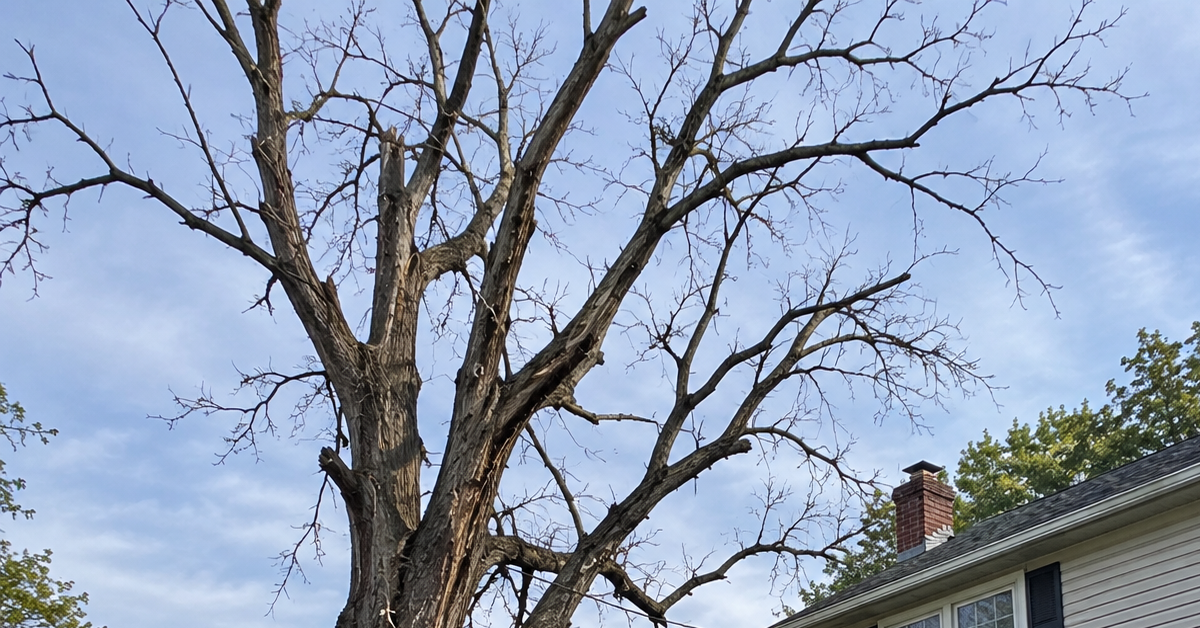
Union County, NJ properties often place mature trees close to houses, garages, sidewalks, driveways, fences, and utility infrastructure. A dead tree in an open woodland may present fewer immediate consequences than the same tree standing beside a home. Location is also an important factor when assessing the potential consequences of tree failure. How tree location and nearby property affect failure risk. It is important to address trees that are dead, decaying, leaning, storm-damaged, or otherwise hazardous.
Why Dead Trees Become a Safety Concern
A living tree actively maintains its tissues and responds to environmental stresses. A dead tree no longer has that ability. Over time, moisture, fungi, insects, weather, and physical deterioration can weaken the wood. The resulting risk is not always obvious from the ground. A tree can retain a relatively solid-looking trunk while major branches have already become compromised.
Dead trees can also become more vulnerable during strong winds, heavy rain, snow, and ice. A branch that appears stable during calm weather may fail when additional forces act on it.
This does not mean every dead tree will fall immediately. It means homeowners should not assume that a standing dead tree is safe simply because it has remained upright for a long time.
Signs a Dead Tree May Need Removal
Several visible conditions can indicate that a tree requires professional attention. How tree decay can weaken branches and trunks.
No Leaves During the Growing Season
A completely leafless tree during the growing season may be dead, although seasonal behaviour varies by species and individual circumstances. A professional assessment can determine whether the tree is actually dead or experiencing severe decline.
Extensive Dead Branches
Dead branches throughout the canopy can indicate significant decline. Large dead limbs are particularly concerning when they extend over areas where people, vehicles, or structures are located.
Peeling or Loose Bark
As trees die and decay progresses, bark may loosen and fall away. Extensive bark loss can expose deteriorating wood beneath it.
Fungal Growth
Mushrooms or fungal fruiting bodies around the trunk or root zone can indicate decay. They do not automatically prove that a tree is unsafe, but they are worth having evaluated.
Trunk Cracks or Cavities
Large cracks, cavities, hollow sections, or damaged trunk areas can reduce structural strength. Their significance depends on the location, size, depth, and overall condition of the tree.
Leaning or Root Disturbance
A newly developed lean or soil movement around the base can indicate root or structural failure. These signs deserve prompt attention, especially when the tree stands near a structure.
Dead Tree vs. Diseased or Declining Tree
One of the most important decisions is determining whether a tree is actually dead. A declining tree may still have viable tissue and may respond to appropriate treatment or pruning. Removing such a tree unnecessarily can eliminate a valuable part of the landscape.
A dead tree, however, cannot recover. The decision shifts toward managing the structural and property risks created by the standing remains. This distinction is one reason to hire an experienced tree service company in Union County, NJ to conduct a detailed tree assessment before arranging complete removal.
Where Dead Trees Create the Greatest Risk
The location of a dead tree can significantly change the consequences of failure.
Near the House
A dead tree within falling distance of a home deserves careful assessment. Large branches can damage roofing, siding, windows, or other structures even if the trunk itself remains standing.
Near Driveways and Vehicles
Trees beside driveways can drop limbs onto vehicles or obstruct access after failure.
Near Walkways
Dead branches over sidewalks or frequently used paths create a direct risk to people below.
Near Utility Lines
Tree work around power lines carries significant safety risks. Homeowners should never attempt to remove a tree or large branch that is entangled with electrical infrastructure.
Near Property Boundaries
A dead tree close to a neighbour’s property can create additional concerns involving fences, buildings, landscaping, and liability.
Should Every Dead Tree Be Removed?
Not automatically. Some dead trees in appropriate locations can provide habitat for wildlife. However, retaining a standing dead tree requires careful consideration of its location, condition, size, and potential targets beneath it.
A dead tree beside a house or public walkway presents a very different risk from one located in a remote section of a large property. If you are considering retaining a dead tree, a tree assessment can help determine whether its location and condition make that option reasonable.
What Professional Dead Tree Removal Involves
Dead tree removal involves much more than simply cutting through the trunk.
- A professional tree removal crew begins by assessing the tree, nearby structures, access points, and potential fall zones. The safest removal method depends on factors such as the tree’s size, condition, location, and site accessibility.
- A tree removal process may include – a thorough site evaluation, careful planning, safe tree removal, debris cleanup, and optional stump grinding. Depending on the project, crews may use ropes, rigging systems, cranes, or bucket trucks to safely complete the work.
- Large or difficult removals require extra caution because dead wood can be unstable and behave unpredictably when cutting pressure is applied.
Why DIY Removal Can Be Dangerous
Dead trees can be more difficult to control than healthy trees because their wood may have lost strength. A homeowner may not be able to determine:
- Which branches remain structurally attached.
- How far internal decay extends.
- Whether the tree will remain stable while sections are removed.
- How the tree will react when tension is released.
- Whether nearby structures or utility lines create additional hazards.
Using a chainsaw without proper training can also create serious personal injury and property-damage risks. Professional removal provides a controlled process designed around the tree’s condition and the surrounding environment.
What Happens After the Tree Comes Down?
Removal does not necessarily end with cutting and hauling away the tree. The remaining stump can interfere with lawn maintenance, landscaping, or future planting. It may also become an obstacle or attract insects as it decomposes. Stump grinding can remove much of the visible stump below ground level, allowing homeowners to reclaim the space for lawn or other landscaping.
When Emergency Removal May Be Necessary
Some situations require immediate attention rather than routine scheduling. Contact a professional promptly when:
- A dead tree has developed a sudden lean.
- Large branches are hanging or partially detached.
- The trunk has split.
- The tree has fallen against a structure.
- A dead tree has become entangled with utility lines.
- Severe weather has damaged an already dead or declining tree.
How NJ Tree Professional Can Help
New Jersey Tree Professional provides tree removal services for dead, decaying, leaning, storm-damaged, and hazardous trees throughout Union County. Our crews are licensed and insured and our removal process begins with a site evaluation before determining the appropriate method. New Jersey Tree Professional’s team can assess the tree’s condition, identify potential hazards, plan access, and select suitable equipment for the removal. Larger or difficult trees may require rigging, bucket trucks, or crane-assisted removal to protect nearby structures and landscaping.
New Jersey Tree Professional offers 24/7 emergency tree service for storm damage, hazardous limbs, fallen trees, and other urgent situations across Union County. Homeowners should keep people away from hazardous trees until professionals can assess the situation. We also provide debris cleanup and optional stump grinding, allowing homeowners to address the tree and the remaining stump as part of the same project.
Frequently Asked Questions About Dead Tree Removal in Union County, NJ
How do I know if my tree is completely dead?
A tree that remains leafless during its normal growing season may be dead, but other conditions can cause temporary or severe decline. An arborist can assess whether viable tissue remains.
Can a dead tree fall without warning?
Yes. Dead wood gradually loses strength, and branches or sections can fail unexpectedly. The timing of failure cannot reliably be predicted simply by observing the tree from the ground.
Should I remove a dead tree immediately?
The urgency depends on its condition and location. A dead tree near a home, walkway, driveway, or utility line generally deserves more immediate attention than one located in an isolated area.
Can I remove a dead tree myself?
Small ground-level material may be manageable for some homeowners, but complete tree removal can involve significant structural and equipment hazards. Large dead trees are best handled by trained professionals.
Does tree removal include stump removal?
Not always. Some companies treat stump grinding as a separate service. New Jersey Tree Professional offers optional stump grinding with its removal services.
Summary Checklist: Removing Dead Trees in Union County, NJ
| Condition | What to Look For | Recommended Action |
| Dead canopy | No foliage during growing season | Schedule an assessment |
| Dead limbs | Large brittle branches | Arrange professional pruning or removal |
| Trunk decay | Cavities, cracks, loose bark | Have the structure evaluated |
| Root concerns | Soil movement or new lean | Seek prompt professional assessment |
| Property exposure | Tree near house or driveway | Prioritise risk evaluation |
| Utility conflict | Tree near power lines | Keep clear and contact professionals |
| Fallen tree | Tree has already failed | Arrange emergency removal if needed |
| Remaining stump | Large stump after removal | Consider stump grinding |
Final Advice
A dead tree does not become dangerous simply because it has stopped producing leaves, but its structural condition can deteriorate over time. The risk becomes more significant when the tree stands close to a home, driveway, walkway, vehicle, utility line, or other target.
Homeowners should avoid assuming that a dead tree will remain stable simply because it has been standing for months or years. A professional assessment can determine whether removal is necessary, whether limited pruning is appropriate, or whether the tree can safely remain in place.
New Jersey Tree Professional provides tree removal, stump grinding, pruning, and emergency tree services for Union County properties.